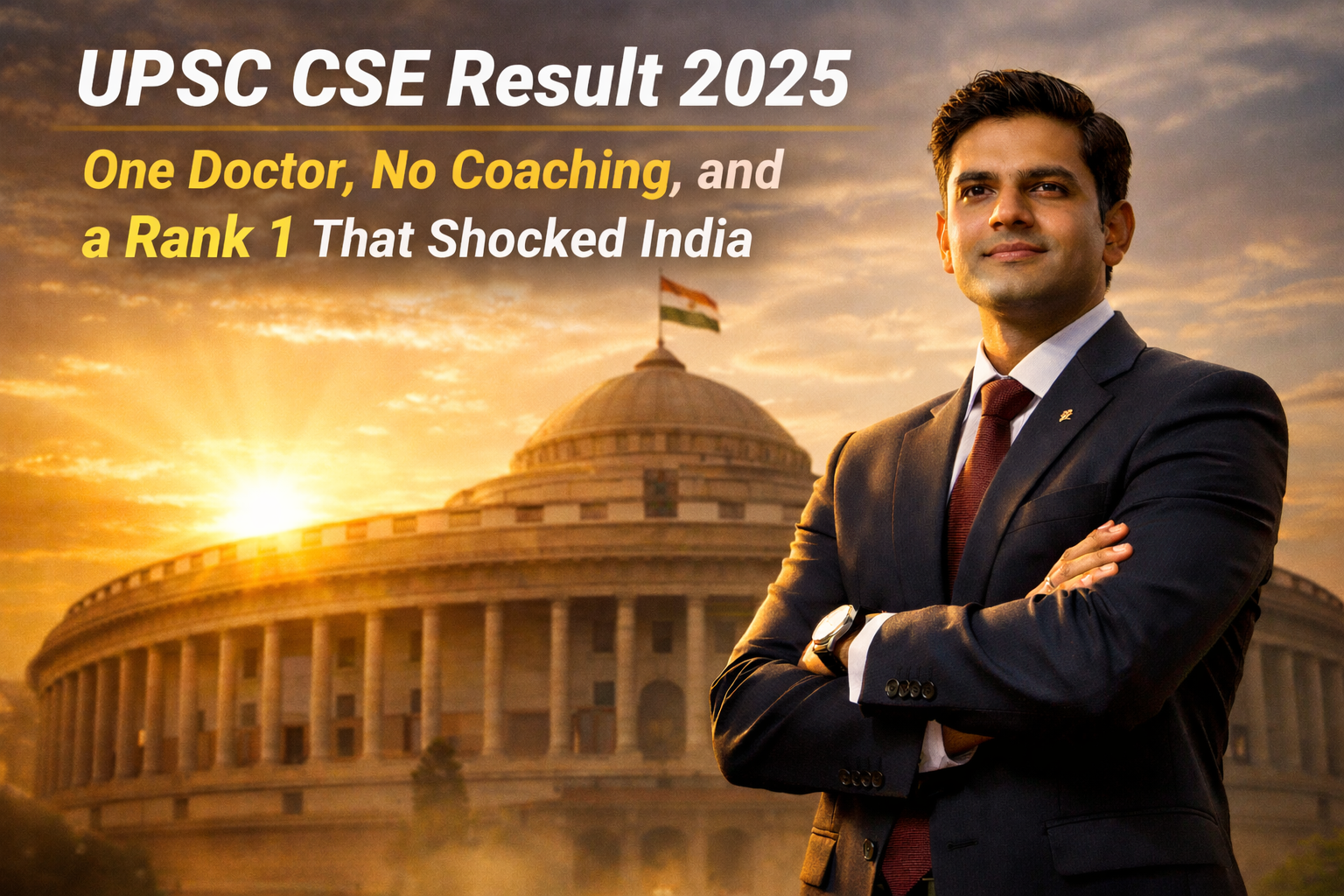
The results are finally out. On 6th March 2026, the Union Public Service Commission officially declared the UPSC Civil Services Examination (CSE) 2025 final result on its official portal—upsc.gov.in.
UPSC CSE 2025 Result: The Big Numbers
A total of 958 candidates have been recommended for appointment across various services. The total number of vacancies was 1,087, distributed across services as follows: 180 seats for IAS (Indian Administrative Service), 55 for IPS (Indian Police Service), 150 for IFS (Indian Foreign Service), 507 for Central Services Group A, and 195 for Central Services Group B.
In addition to the main list, the commission has maintained a reserve list of 258 candidates to fill any vacancies that arise due to candidate non-joining or other administrative reasons. The candidature of 348 recommended candidates has been kept provisional, pending document verification.
Candidates can expect their individual marks to be made available on the official website within 15 days from the date of result declaration. This helps unsuccessful candidates benchmark their performance and plan their next attempt more strategically.
The sheer scale of this exam is worth appreciating: lakhs of candidates appear for the preliminary examination, only a fraction clear it to the mains, and fewer still make it to the personality test (interview). Of those who reach the final stage, under 1,000 are ultimately recommended—making the UPSC CSE one of the most selective examinations in the world.
Meet the Toppers: UPSC CSE 2025 Top 5
AIR 1 — Anuj Agnihotri (Chittorgarh, Rajasthan)
The most talked-about name from this year’s results is Anuj Agnihotri, who secured All India Rank 1. A doctor by training, Anuj completed his MBBS from AIIMS Jodhpur — one of India’s most prestigious medical institutions — before setting his sights on the civil services.
What makes his story particularly compelling is the manner in which he achieved this feat. Anuj cracked the exam on his third attempt, without any formal coaching. He studied approximately 13 hours per day and chose medical science as his optional subject, leveraging his medical background to gain a competitive edge.
His journey reflects a pattern seen among many successful UPSC toppers — deep domain knowledge, disciplined self-study, and the resilience to bounce back from previous attempts. The fact that he achieved rank 1 without coaching is a powerful message to aspirants across the country: institutional support helps, but it is not the deciding factor.
AIR 2 — Rajeshwari Suve M (Female Topper)
Rajeshwari Suve M secured All India Rank 2 and is the female topper of UPSC CSE 2025. Her achievement is an inspiration to thousands of women aspirants who balance societal expectations with the demanding preparation this exam requires.
AIR 3 — Akansh Dhull
Akansh Dhull claimed All India Rank 3, rounding out the top three. His selection is yet another testament to the quality of candidates emerging from across India’s diverse geographies and backgrounds.
AIR 4 — Raghav Jhunjhunwala
Raghav Jhunjhunwala secured the fourth rank nationally, continuing a tradition of strong performances from candidates with business and finance backgrounds who pivot toward public service.
AIR 5 — Ishan Bhatnagar
Rounding out the top five is Ishan Bhatnagar at AIR 5. Each of these five candidates represents years of relentless preparation, sacrifice, and intellectual discipline—qualities that define the civil servant the UPSC seeks to select.
What Does It Take to Clear UPSC CSE? Lessons from the Toppers
The UPSC Civil Services Examination is a three-stage process: Preliminary Exam (Prelims), Main Exam (Mains), and Personality Test (interview). Together, they test a candidate’s knowledge, analytical ability, communication skills, and overall personality. Here are the key lessons aspirants can draw from the strategies of those who have succeeded.
1. Choose Your Optional Subject Wisely
The optional subject in the main examination carries 500 marks (two papers of 250 marks each) and can significantly impact your overall score. Anuj Agnihotri’s use of medical science is a prime example of leveraging prior academic expertise. Choose a subject you genuinely understand and enjoy — not one that seems “easier” based on hearsay.
2. Consistency Over Intensity
Toppers rarely study 18 hours a day. What distinguishes them is consistent, structured study over a long period. Anuj’s routine of 13 focused hours daily — maintained over months — is more representative of what success looks like than sporadic bursts of intense study.
3. NCERT Foundation is Non-Negotiable
Regardless of your background, NCERT textbooks (Class 6 to Class 12) form the bedrock of UPSC preparation. History, Geography, Polity, Economics, Science, and Technology—all GS topics trace back to concepts first introduced in NCERTs. Read them thoroughly before moving to standard reference books.
4. Answer Writing is a Skill, Not a Talent
The mains examination is entirely subjective. Many aspirants neglect answer-writing practice until it is too late. The best candidates dedicate significant time to writing answers under timed conditions, getting them reviewed, and improving structure, content, and presentation. Start writing answers from Day 1 of your preparation.
5. Current Affairs: Quality Over Quantity
One of the most common mistakes aspirants make is drowning in current affairs. The UPSC does not require you to memorize every news item. Instead, focus on understanding policy decisions, government schemes, international relations, economic trends, and social issues in depth. Connecting current events to static syllabus topics is the key.
6. Mock Interviews and Personality Development
The personality test is not just about what you know—it is about who you are. Invest time in mock interview sessions, develop a clear, detailed application form (DAF), and be honest about your academic background, hobbies, and opinions. The interview board rewards authenticity and intellectual maturity.
7. Manage Failure with Grace
Most successful candidates — including rank holders — did not clear the exam on their first attempt. Anuj Agnihotri’s journey to AIR 1 came in his third attempt. Failure is not the end; it is data. Analyze what went wrong, recalibrate your strategy, and return stronger.
The IAS Dream: Why Millions Still Chase It
In an era of lucrative private sector opportunities and startup culture, why do lakhs of India’s brightest minds still queue up every year to become civil servants?
The answer is multifaceted. For many, it is the scale of impact—an IAS officer can influence the lives of millions through policy implementation, disaster management, and administrative reform. For others, it is the stability and prestige that the services offer. And for a growing number, it is a deeply personal sense of purpose—a desire to serve the country in a direct and meaningful way.
The UPSC examination, for all its rigor and difficulty, is also one of India’s most egalitarian selection processes. It does not care where you went to school, what your family background is, or whether you studied at a premium coaching institute. If you have the knowledge, the writing ability, and the intellectual clarity, you have a shot.
That is perhaps the most powerful thing about the UPSC result announcement every year — it demonstrates, year after year, that merit can still open doors in India.
How to Check Your UPSC CSE 2025 Result
If you appeared in the UPSC CSE 2025 and have yet to check your result, here is how to do it:
- Visit the official UPSC website: upsc.gov.in
- Navigate to the “What’s New” section on the homepage
- Click on the link for “Final Result—Civil Services Examination, 2025.”
- A PDF file will open. Use Ctrl+F to search for your name or roll number
- If you are recommended, your name, roll number, and rank will be listed in the document
Final Thoughts
The UPSC CSE 2025 result is more than a list of names. It is the culmination of thousands of individual journeys—of late nights, abandoned social lives, financial sacrifices, and unwavering belief. To every candidate who made it, congratulations. To every candidate who did not, your effort was not wasted. The knowledge you have gained, the discipline you have built, and the resilience you have developed are assets that no result can take away.
Stay updated with all UPSC-related news, exam notifications, and preparation tips right here on our website. The next UPSC cycle has already begun — and so has your journey toward it.